


Garden Lights perform several functions at the same time. They help people move safely after dark, make entrances and gathering areas easier to identify, support security and contribute to the nighttime appearance of the landscape.
However, selecting a garden light only according to appearance can lead to excessive brightness, uncomfortable glare, dark areas or a product that does not suit the installation environment. A successful Garden Pathway Lighting project should coordinate the fixture type, mounting height, spacing, optical distribution, color temperature, protection level and control method.
The following guide explains the main factors that project owners, landscape designers, contractors and property developers should evaluate before choosing garden lights.
1. Define the Lighting Application
The first step is to identify where the lights will be installed and what they need to achieve. A narrow residential path has different requirements from a hotel courtyard, public garden or community entrance.
Common Garden Lighting applications include:
Pedestrian paths and walkways
Residential communities
Villa gardens and private courtyards
Hotel and resort landscapes
Parks and recreational areas
Building entrances and drop-off zones
Public squares and landscaped plazas
Outdoor seating and gathering areas
Lawns, flower beds and planted areas
Access routes between buildings
The main objective may be safe movement, decorative enhancement, general illumination, route guidance or a combination of these functions. Defining the application prevents the project from using the same fixture and brightness level in every outdoor area.
2. Collect the Site Information
Garden light selection should begin with an accurate understanding of the site. The supplier or lighting designer will need more than the total project area to recommend a suitable configuration.
Useful project information includes:
Site plan and landscape drawings
Width and length of pedestrian routes
Location of entrances, steps and gathering areas
Existing trees, walls and buildings
Planned pole positions
Available electrical supply
Required operating hours
Preferred architectural or landscape style
Local temperature, rainfall and wind conditions
Required lighting standards
Maintenance access
Possibility of future landscape growth or modification
Trees and shrubs deserve particular attention. A small tree shown on the original landscape drawing may eventually block the light or interfere with maintenance. Pole positions should therefore consider both the current layout and expected plant growth.
3. Choose the Appropriate Fixture Type
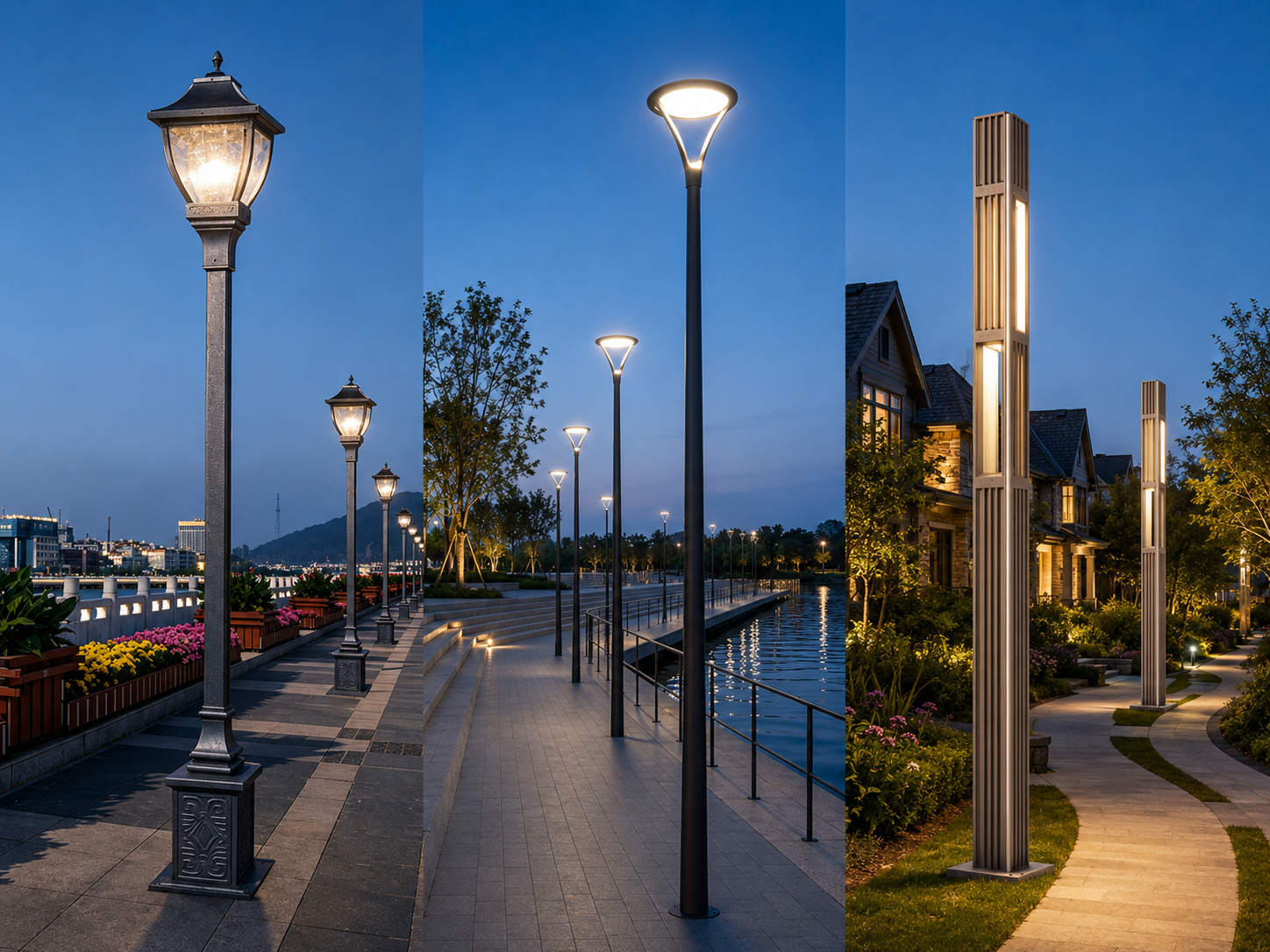
Different garden light designs create different visual effects and mounting conditions. The correct choice depends on the scale of the site, required coverage, architecture and maintenance strategy.
Fixture Type | Main Characteristics | Suitable Applications |
Classic post-top garden light | Traditional lantern or post-top appearance with broad surrounding illumination | Residential communities, traditional buildings, courtyards and hotel landscapes |
Modern LED garden light pole | Simple contemporary form with integrated LED optics | Modern communities, commercial landscapes, parks and pedestrian routes |
Decorative courtyard light pole | Combines lighting with a stronger architectural or ornamental character | Plazas, entrances, resorts, themed streets and landmark areas |
Pedestrian garden light | Moderate mounting height and controlled lighting for walking areas | Paths, residential areas, campuses and recreational spaces |
Bollard light | Low-level fixture that defines path edges and nearby landscape features | Narrow walkways, gardens, lawns and building approaches |
Wall-mounted light | Mounted on buildings or landscape walls without a separate pole | Entrances, terraces, perimeter walls and service routes |
A project may use more than one fixture type. For example, taller garden poles can provide general illumination while bollards or wall lights identify smaller paths and entrances. The products should share compatible colors, materials and design elements so the site retains a coordinated appearance.
4. Match the Product Style to the Surroundings
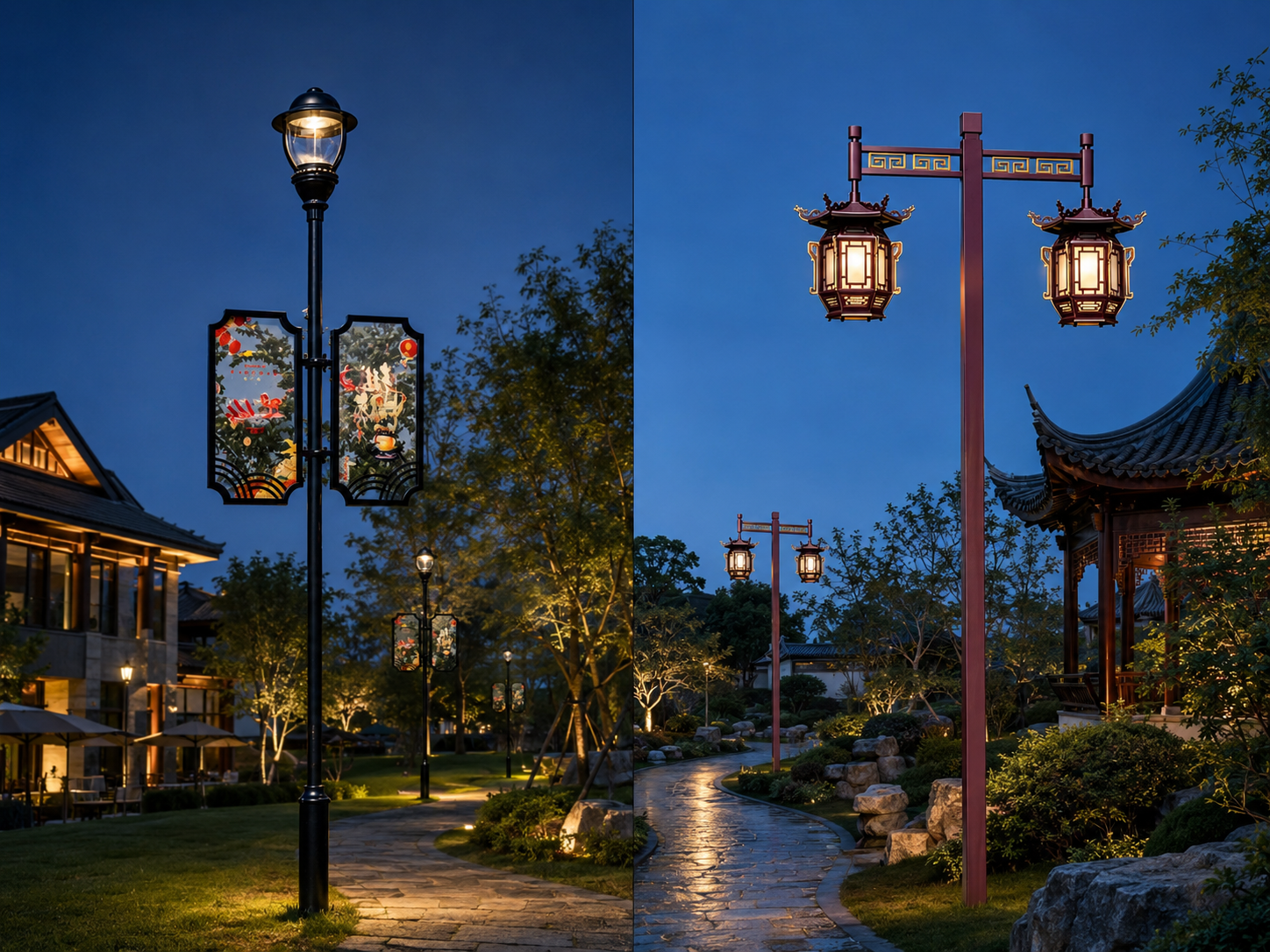
Garden lights remain visible during the day, so their appearance is part of the landscape design even when they are not operating.
Modern buildings often work well with clean lines, simple poles and restrained colors. Traditional architecture may require lantern-style fixtures, decorative brackets or poles with ornamental details. Chinese-style buildings and cultural landscapes may benefit from products that incorporate suitable roof, frame or lantern elements.
Decorative Garden Lighting should support the character of the project without becoming visually excessive. The pole, luminaire head, mounting arm, base and surface finish should appear as one complete design.
The following elements should be coordinated:
Fixture proportions
Pole height and diameter
Luminaire shape
Bracket and arm design
Surface color and texture
Nearby benches, signs and landscape furniture
Building façade materials
Daytime appearance
Custom colors and decorative details may be available, but they should be confirmed with the manufacturer for the selected product and project quantity.
5. Select a Suitable Mounting Height
Mounting height affects coverage, glare, pole spacing and the visual scale of the lighting installation. A very low fixture may create strong brightness close to the light but fail to illuminate a wider area. An excessively tall pole may appear unsuitable in a small courtyard.
Lighting Application | Preliminary Mounting Height | Main Design Consideration |
Bollards and low-level lights | 0.6–1.2 m | Path-edge guidance and nearby landscape illumination |
Pedestrian garden lights | 2.5–4 m | Comfortable pedestrian-scale coverage |
Garden and courtyard poles | 3–5 m | Balanced general illumination and visual proportion |
Taller area-Lighting Poles | 5–8 m | Broader coverage for entrances, plazas and larger public spaces |
These ranges are preliminary references rather than fixed specifications. The final mounting height should be selected according to the fixture optics, site dimensions, required illumination, pole spacing and local standards.
6. Coordinate Pole Spacing and Optical Distribution
Pole spacing cannot be determined reliably by wattage alone. Two garden lights with the same power can create very different coverage because of their mounting height, lens design and light distribution.
Important factors include:
Path width
Mounting height
Fixture position relative to the path
Single-sided or staggered arrangement
Required average illumination
Minimum illumination between fixtures
Nearby walls and reflective surfaces
Trees or structures that may block the light
Spacing that is too wide can create alternating bright and dark zones. Spacing that is too close may increase energy use, installation cost and visual clutter.
For straight paths, a consistent layout usually provides clear route guidance. Curved paths, steps, entrances and intersections may require individual adjustments. Lighting simulation or a sample installation is recommended when the project includes irregular geometry.
7. Set Appropriate Illumination and Uniformity
More light does not automatically create a better outdoor environment. Garden and pedestrian spaces generally benefit from balanced illumination that allows people to recognize the route, surface changes, obstacles and other users.
The lighting design should evaluate:
Average horizontal illuminance
Minimum illuminance
Uniformity along the walking route
Vertical illumination for recognizing people and entrances
Brightness differences between adjacent areas
Light near steps, ramps and changes in level
Interaction with building and Landscape Lighting
A brightly illuminated entrance beside a very dark path can make the path appear less visible because the eyes need time to adapt. Transitional areas should therefore be included in the lighting plan.
Final illumination requirements should follow the applicable local standard and the function of the space.
8. Control Glare for Pedestrian Comfort
Glare is one of the most common problems in garden lighting. It occurs when a bright light source is visible at an uncomfortable angle or when the fixture produces much more brightness than the surrounding environment.
Glare can be reduced by:
Using controlled optical distributions
Selecting an appropriate mounting height
Avoiding direct views of exposed LED modules
Using shields or suitable fixture structures
Reducing excessive wattage
Positioning lights away from windows and seating areas
Maintaining balanced brightness throughout the site
Adjusting the fixture orientation during installation
Low-level lights require particular care because their light source may be close to the normal line of sight. A product that appears comfortable in a catalogue image should still be evaluated according to its actual installation height and viewing direction.
9. Select Color Temperature and Color Rendering
Color temperature influences atmosphere, visual comfort and the appearance of plants, paving and building materials.
Color Temperature | Visual Character | Typical Applications |
2700K–3000K | Warm and comfortable appearance | Residential gardens, hotels, restaurants and traditional landscapes |
3500K–4000K | Neutral appearance with clear visual conditions | Communities, campuses, parks and mixed-use outdoor areas |
5000K and above | Cooler and more visually intense appearance | Selected functional areas where permitted by project requirements |
Warm or neutral-white lighting is often preferred in pedestrian and landscaped environments because it can create a more comfortable nighttime atmosphere. High color temperatures should be used carefully, particularly near residences or environmentally sensitive areas.
Color rendering is also important when the project needs people, plants, artwork or architectural materials to appear natural. The required CRI should be specified according to the visual purpose of the area.
Using one coordinated color temperature across related areas usually produces a more consistent result than mixing noticeably different light colors without a design reason.
10. Compare Grid-Connected and Solar Options
Garden lights can be powered by a conventional electrical network or by an independent solar system. Each option has practical advantages and limitations.
System Type | Main Strengths | Important Considerations |
Grid-connected lighting | Stable power supply, flexible operating schedules and easier use of higher lighting loads | Requires cables, electrical protection, trenching and access to a suitable power source |
Reduced cabling and suitable for locations without convenient grid access | Panel exposure, battery capacity, solar radiation, cloudy days and seasonal conditions must be evaluated | |
Hybrid configuration | Can combine renewable energy with backup power where required | More complex controls and electrical design may be needed |
Solar Garden Lights can be useful for parks, remote paths and existing landscapes where trenching would be disruptive. However, a solar product should not be selected only according to the advertised LED wattage. The panel, battery, controller, dimming schedule and local solar conditions must be matched as one system.
11. Check Outdoor Protection and Materials
Garden lights operate close to soil, plants, irrigation systems and pedestrian activity. Their construction must be suitable for long-term outdoor exposure.
Important specifications include:
Ingress protection against water and dust
Impact resistance
Corrosion-resistant housing and fasteners
Durable pole surface treatment
UV-resistant optical and sealing materials
Suitable operating temperature range
Electrical surge protection
Reliable cable entry and sealing
Resistance to irrigation water and ground moisture
IP65 or IP66 protection is commonly considered for many outdoor luminaires, but the required level depends on the product structure and installation environment. The confirmed protection rating should always refer to the selected model rather than the product category in general.
Coastal areas, industrial environments and locations using chemical cleaning products may require additional corrosion protection. Pole material, coating thickness, pretreatment and fastener selection should be confirmed with the manufacturer.
12. Plan the Pole Foundation and Cable Routes
A reliable luminaire cannot compensate for an unsuitable foundation or poor electrical installation. The pole, base plate, anchor bolts, foundation and cable routes should be designed as a complete assembly.
The foundation design should consider:
Pole height and weight
Luminaire quantity and mounting arrangement
Local wind conditions
Soil and drainage conditions
Anchor-bolt dimensions
Access for electrical connection
Protection against standing water
Local structural requirements
Garden beds may receive frequent irrigation, so cable joints and access doors should not be positioned where water can accumulate. Underground cables should follow the applicable electrical and construction standards.
Before pouring foundations, contractors should confirm pole spacing, bolt orientation, cable entry and finished ground level. Correcting these details after the concrete has cured can delay installation and increase project cost.
13. Select Controls and Dimming
Lighting controls can reduce energy consumption and adapt the outdoor environment to different periods of the night.
Available control methods may include:
Photocell-based automatic switching
Astronomical time control
Scheduled dimming
0–10V or 1–10V dimming
DALI control
Motion sensors
Centralized lighting management
Remote fault monitoring
Motion-based dimming can be suitable for low-traffic paths, private gardens and selected community areas. The background level should still allow people to understand the route before the system increases brightness.
Busy entrances, public squares and emergency access routes may require more consistent illumination. Control settings should therefore match the actual use and safety requirements of each area.
14. Reduce Light Spill and Environmental Impact
Outdoor Lighting should illuminate the required area without sending unnecessary light into windows, trees or the sky.
Light spill can be reduced through:
Accurate optical selection
Suitable pole positioning
Lower mounting heights where appropriate
Shielding near residential windows
Warm or neutral color temperatures
Dimming during low-activity periods
Avoiding upward-facing light where it is not required
Using the minimum suitable output for the task
Lighting trees and landscape features can create visual interest, but the direction, operating time and brightness should be carefully controlled. Excessive Decorative Lighting can increase energy consumption and disturb nearby residents or wildlife.
15. Plan Maintenance and Lifecycle Cost
The initial product price represents only one part of the total project cost. Long-term expenses may include energy, cleaning, driver replacement, coating repair and access equipment.
Inspection Item | What to Check |
Luminaire and lens | Dirt, water ingress, discoloration, damage and reduced light output |
Pole and surface finish | Corrosion, scratches, loose components and coating deterioration |
Base and foundation | Loose anchor nuts, cracking, settlement and standing water |
Electrical compartment | Cable condition, connection security, driver operation and sealing |
Controls | Switching time, dimming schedule, sensors and communication status |
Surrounding landscape | Branches, leaves or new construction blocking the light |
Replaceable drivers and LED modules can simplify maintenance when compatible parts remain available. Buyers should ask about spare components, access methods, warranty conditions and technical support before confirming the order.
For larger projects, recording model numbers, driver specifications, installation locations and commissioning settings can make future maintenance more efficient.
16. Avoid Common Garden Lighting Mistakes
16.1 Selecting Products Only by Appearance
A visually attractive fixture may still produce unsuitable light distribution, excessive glare or insufficient coverage.
16.2 Using Too Much Light
Excessive brightness can reduce comfort, increase energy consumption and make adjacent areas appear darker.
16.3 Determining Spacing Without Photometric Data
Visual estimates do not account for the actual optical distribution of the proposed product.
16.4 Installing Lights Directly in the Line of Sight
Incorrect positioning can expose pedestrians or nearby residents to uncomfortable glare.
16.5 Mixing Uncoordinated Color Temperatures
Different light colors can make the landscape appear inconsistent unless the contrast is part of an intentional design.
16.6 Ignoring Drainage and Irrigation
Water around cable joints, access doors or foundations can create reliability and safety problems.
16.7 Ignoring Future Tree Growth
Plants may eventually block the light or make maintenance difficult if pole positions are too close to landscaped areas.
16.8 Choosing a Product Without a Maintenance Plan
Specialized components may become difficult to replace if spare parts and access methods are not considered during product selection.
17. Information to Send to the Manufacturer
Complete project information allows the supplier to recommend a more accurate fixture, pole and optical configuration.
The enquiry should include:
Project country and city
Site plan or landscape drawing
Path and courtyard dimensions
Required lighting level or applicable standard
Preferred fixture style
Proposed mounting height
Available pole positions
Input voltage and frequency
Preferred color temperature
Control or dimming requirements
Environmental and corrosion conditions
Local wind requirements
Required certifications
Estimated project quantity
If the lighting layout has not been completed, the supplier can be asked to prepare a preliminary configuration or lighting simulation based on the project drawings.
Conclusion
Choosing garden lights is a coordinated design process involving visibility, visual comfort, product appearance, optics, pole height, spacing, outdoor reliability and maintenance.
For effective Courtyard Lighting, the fixture should complement the surrounding architecture while directing the required amount of light onto paths, entrances and activity areas. Product appearance and lighting performance should therefore be evaluated together.
Baode Lighting provides project-based garden lighting products, lighting poles, decorative configurations and engineering support for residential, commercial and public outdoor spaces. Customers can provide site drawings, design preferences and technical requirements to receive a customized product and lighting recommendation.
FAQ
1. What is a suitable height for a garden light pole?
Pedestrian-scale garden poles are often approximately 2.5–5 metres high, while bollards are commonly below 1.2 metres. The final height depends on the site scale, optical distribution, spacing and required illumination.
2. How far apart should garden lights be installed?
Spacing depends on fixture output, mounting height, optical distribution, path width and required uniformity. Photometric data or lighting simulation should be used instead of applying one fixed spacing to every product.
3. What color temperature is suitable for a garden?
Warm-white light around 2700K–3000K is often suitable for residential and hospitality landscapes. Neutral-white light around 3500K–4000K may be selected for communities, parks and other functional outdoor areas.
4. Are solar or grid-connected garden lights better?
Neither option is suitable for every project. Solar lights can reduce trenching and work well in locations with sufficient sunlight, while grid-connected products provide stable power and greater flexibility for continuous operation.
5. What IP rating should an outdoor garden light have?
IP65 or IP66 is commonly considered for outdoor lighting, depending on the fixture design and exposure. The selected model should be evaluated for rain, dust, irrigation and local environmental conditions.
6. How can glare from garden lights be reduced?
Use controlled optics, appropriate mounting heights, shields where required and a suitable lighting output. Products should also be positioned so that bright LED sources are not directly visible from paths, windows or seating areas.
7. Can the pole style and color be customized?
Many project-based products can be configured with different pole styles, surface colors, mounting arrangements and decorative details. Available options should be confirmed for the selected model and order quantity.
8. Is lighting simulation necessary for a garden project?
Simulation is particularly useful for larger courtyards, communities, hotels, parks and irregular pathways. It helps confirm illumination, uniformity, glare, pole spacing and luminaire quantity before installation.


Comente
(0)